Please note: I participate in the Amazon Associates program. The following blog article contains a link to a product that I could earn a small commission on. I only share products I have experience with or hope to some day try for myself. Thank you if you chose to show your support!
The Prong or “Pinch” Collar has to be one of the most controversial tools in dog training along side the electric shock collar. This winter, while on our annual cousins trip to see a hockey game in Philadelphia, my cousin and I were waiting on an elevator to take us down to the lobby and when the doors opened, this adorable Viszla got off. As soon as the owners were out of sight I said to my cousin “Oh I feel so bad for that dog it’s on a prong collar, that’s so cruel!” But much to my surprise she said “Oh my dad used one for his dog, they aren’t cruel.” It occurred to me that sometimes people are unaware that there are other methods of training which could create a stronger bond between dog and owner and offer faster results.
So, let’s look at the prong collar a little closer. Except, wait I can’t even get a stock image or an AI generated image of a prong collar on Canva! (Edit, here is a picture of one I took at PetSmart…looks super comfy doesn’t it…)
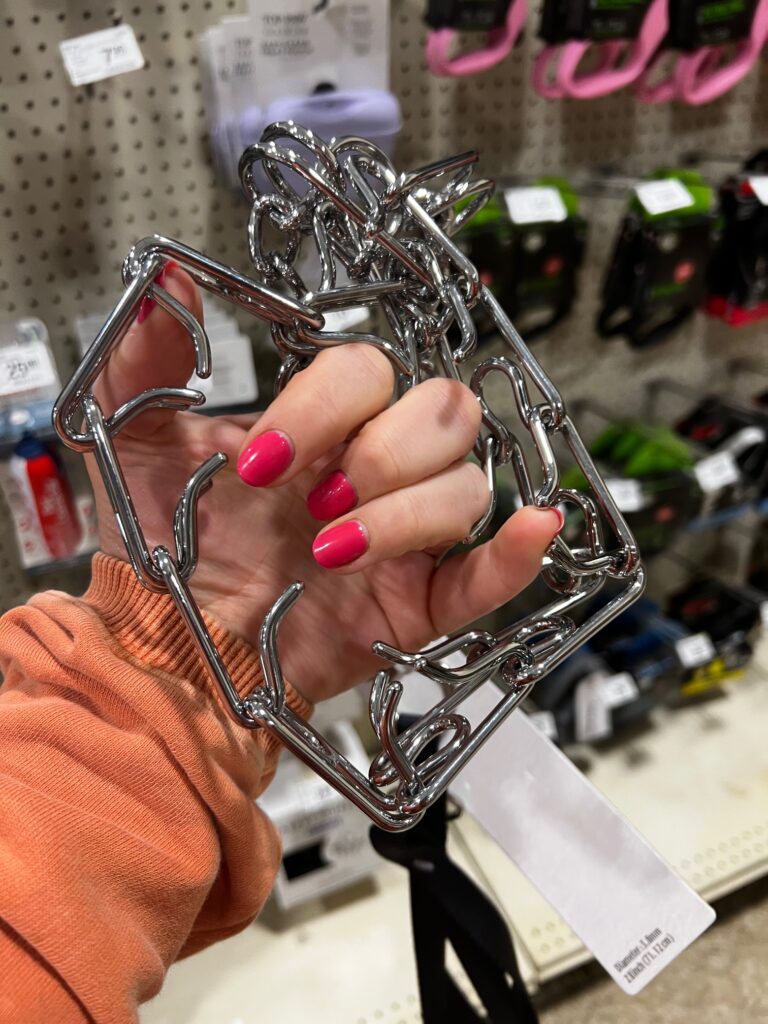
So what is this thing? It turns out that the concept of the prong collar is actually pretty old. If you google “history of the prong collar” you eventually find that the modern day prong collar was invented by Herm. Sprenger in the late 1800’s with the design goal of creating gentle pressure, that is supposed to resemble another dog’s “nip” or correction from a pack member. Well that doesn’t sound so bad, does it?
When was the last time you saw a human use a prong collar in a gentle way? How many times have you seen an owner totally checked out, walking their dog not talking to it and then yank on the dog’s leash (and consequently neck) to get it to continue walking instead of stopping to sniff. Is a correction really necessary here in the first place? My observation is that most people use a prong collar if they need results fast; like immediately fast; they don’t have the patience to slowly work through a problem. But this often isn’t a good solution in the long term.
According to Coaching People to Train Their Dogs, by Terry Ryan, it is important to understand that dogs have the potential to become very confused while being trained with a prong collar. This is because the prong collar works by causing pain, and the dog may learn to identify a visual stimulation – such as another dog, or a person – as the cause for this pain. “When the collar is tightened the dog may lash out at whatever is close, including the handler. Some owners mistakenly use pinch collars for dogs that lunge at others. This might result in a dog becoming more reactive when he associates the pinch with the person or dog approaching.” …” In many cases, the dog reverts to previous behavior when the collar is removed. In other words, no real training took place.” (Ryan, T. 2008, P. 105)
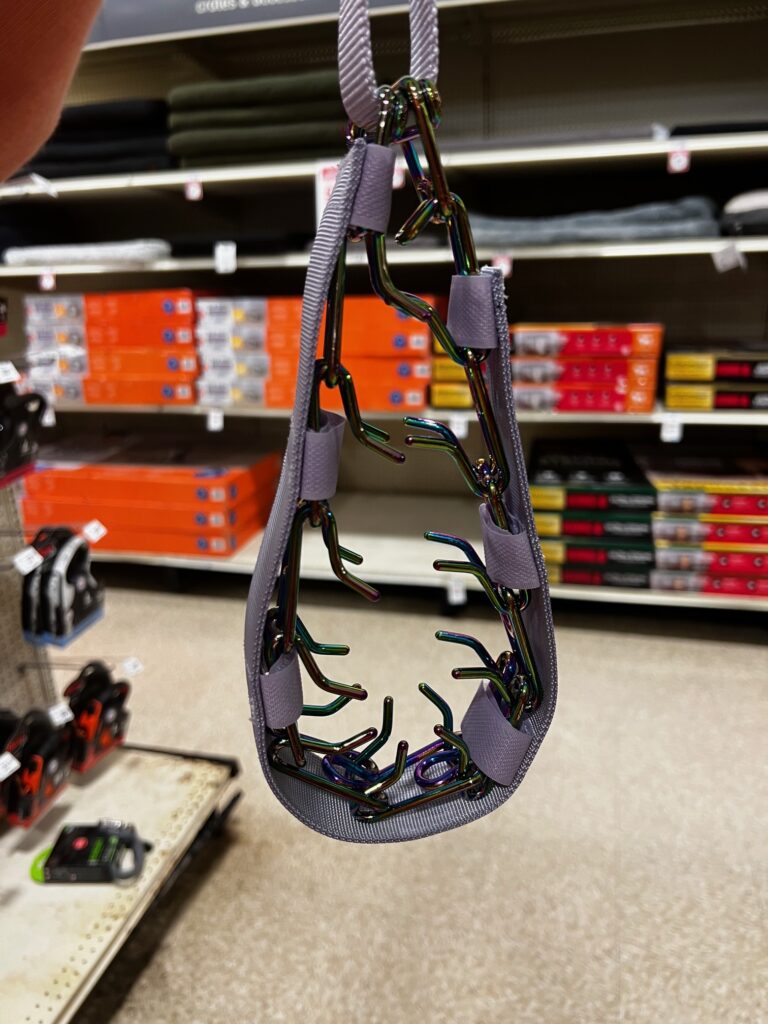
My experience with prong collars is this: I set Apollo up on a play date with two of his littermates. Apollo entered their yard, his brother was on a prong collar and his owner kept correcting him for trying to go say hello. This created a situation in which his brother was looking at Apollo and getting punished. When his owner decided to let him go, he lunged at us and attacked Apollo. I have a scar on my palm to commemorate the ordeal.
So let’s turn to the experts shall we?
I think Emma Parsons covers this the best in The New Click to Calm. We are quick to want to modify behavior like reactivity which can be embarrassing for us humans. We see a prong collar as an option that can quickly turn things around for us but that isn’t necessarily the case and can do more damage than good. She writes “First of all, consider that physical punishment can be abusive, and, to maintain the original threshold of the suppressed behavior, it may have to be administered in increasingly intense doses.” (Parsons, 2021,p.14) Meaning, let’s say you get the reaction you are hoping for with one yoink on the dogs prong collar under minimal distraction. Okay great, but then you decide to take him on a longer walk and there are more distractions and that one yoink isn’t quite cutting it, now you have to yoink harder or maybe longer or both? Next thing you know you could be causing physical harm to your dog. Prong collars, even when fitted “correctly”, can cause skin irritation, neck punctures (google this, it’s DISTURBING!); they can cause spinal chord and back issues, crushed or collapsed tracheas and whiplash. Using punishment as a training method can “put the dog at risk of developing hyper-vigilance, irrational fear, hypersensitivity, heightened irritability, implosive/explosive behavior, hyperactivity, aggression evoked with minimal provocation, withdrawal and social avoidance, loss of sensitivity to pleasure and pain, and depressed mood.” (Parsons, E. 2021,p.14) Emma shares the story of how her dog, Ben, was corrected by a so called expert trainer with a prong collar and as a result his behavior escalated to include reactivity to all dogs rather than just a growl at a few.
The thing that is so sad about this from my point of view is that it can actually damage the relationship that you have with your dog. I’m sure you didn’t get a dog for the sake of punishing it and causing it pain. “You want your dog to feel safe with you, not threatened. Moreover, fear stops the learning process for both humans and dogs. The most serious danger in using punishment is that it often can feel good to the punisher, which mistakenly leads us to believe that we have ‘fixed’ the behavior. The next time, we might be tempted to punish harder and faster.” (Parsons, 2021,p.14)
The greatest failing though, is that it doesn’t teach our dog what we want them to do instead. Imagine you are 16 (maybe younger in other states or countries) and you just got your learners permit. Your parents are old school and they are making you learn on a standard instead of letting you off easy on an automatic transmission. Those of us who have been there know it’s complicated enough on back roads let along when you venture into town for the first time with a hill stop. It feels like everyone is on your rear bumper when you have a hill stop. Now imagine that you are trying to learn standard, and instead of your parents telling you to ease out the clutch as you gently shift and add some gas, they pinch your neck because you’ve done it wrong. Well, do that enough times and you’re likely to have a total melt down with that teenage hormonal brain of yours. That’s almost exactly what’s happening in the case of the prong collar. You’re telling the dog *NOT THIS*, and not only is it unlikely that the dog connects the punishment with the behavior you don’t want, but what should the dog do instead?
In summary physical punishment can:
- lead to abuse
- damage trust
- physically harm
- make behavioral issues worse
- and it does not help the dog learn an alternative and desired behavior

There is good news though. We have learned so much since these collars were invented. We have now learned that when we shape a dogs behavior and reinforce it with something positive and desirable, dogs are quicker to learn what you are asking them. Think back to your teenage-self trying to learn that standard transmission. If you are being pinched when you try something new and make a mistake, you aren’t being told how to achieve success, you are just being told to not do an action, even though you might not understand what that action is. But if you are being told what you are doing is right, you are more likely to find success and be satisfied and proud of your accomplishment. You will want to rehearse that behavior more often to achieve the feeling of success. The same thing happens with dogs who are trained using positive reinforcement along with behavior shaping, which I’d love to cover in a future post. I hope that this post has provided some new perspective on the use of Prong Collars and that you will consider having a look at this amazing book The New Click to Calm, by Emma Parsons which I have linked above.
Reference:
Parsons, E. (2021) The New Click to Calm, Sunshine Books, Inc
Ryan, T. (2008) Coaching People to Train Their Dogs, Legacy Canine Behavior & Training, Incorporated